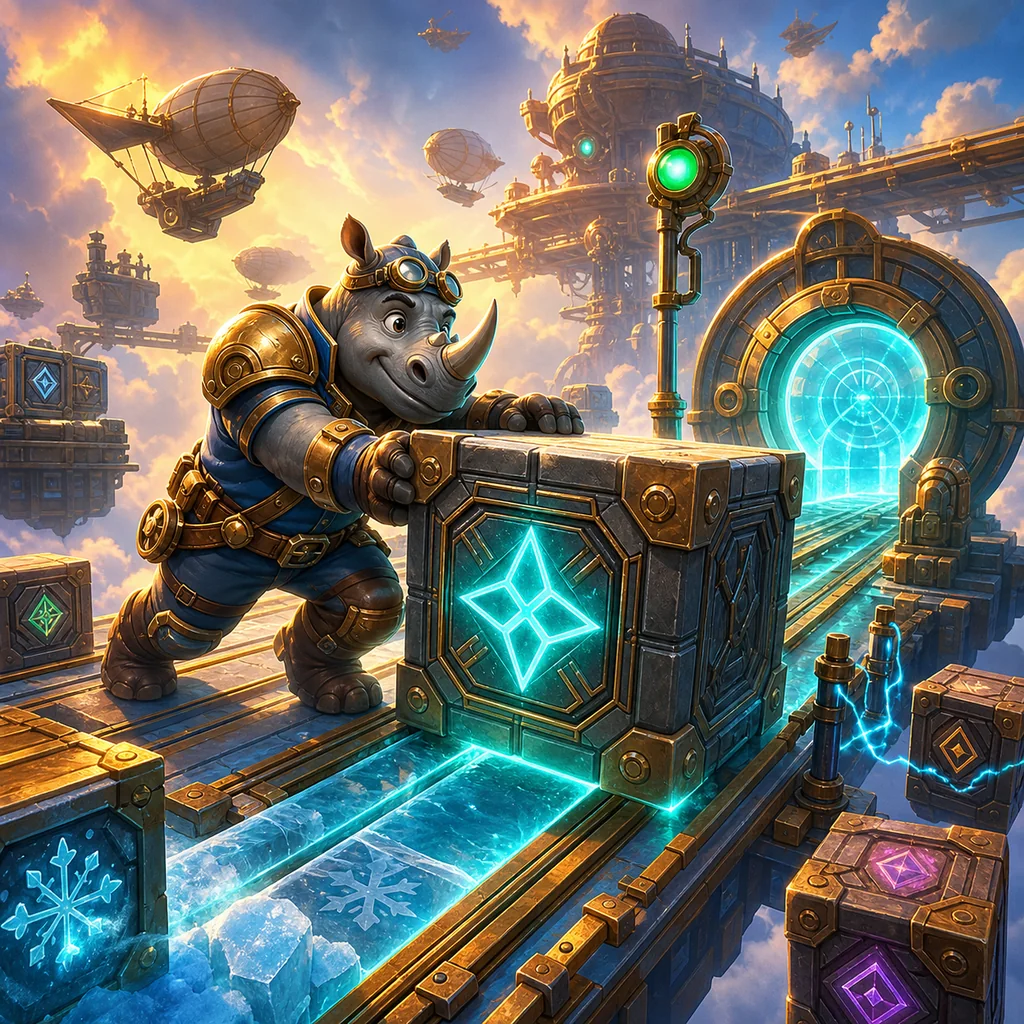
Gearpack Expedition
Gearwood Adventure
Gearpack Expedition
Pack equipment, build adjacency combos, and guide Rux through the Gearwood route.
0 / 30 expeditions cleared
Gearpack Expedition
Gearwood Adventure
Pack equipment, build adjacency combos, and guide Rux through the Gearwood route.

Animal Gearpack Expedition is a 30-stage spatial-inventory strategy adventure starring Gear Horn Rux. Fit equipment into an eleven-column, seven-row pack, connect Forge, Nature, Crystal, and Moon materials, and survive five encounters per stage. Six regions introduce different packing pressures, and every fifth stage ends with a Guardian whose mechanic changes what a safe build looks like.
Gearwood's caravan road once linked six workshops. The route failed when its vaults reacted to the cargo: roots blocked the forest, crystals split the quarry, machines restarted in Clockwork Hollow, the foundry overheated, storm coils charged the observatory, and the Eclipse Vault sealed every recovered shipment behind a final mechanical army.
Gear Horn Rux is the caravan packmaster, while Moon Cap Orla follows with a travelling shop. Clearing a stage reopens one section of road. Defeating the Root Guardian, Crystal Warden, Hollow Colossus, Furnace Leviathan, Tempest Archon, and Eclipse Hoardmaster restores all six regions and releases the stored cargo.
The gearpack has eleven columns and seven rows. Items use different cell shapes and may be rotated before placement. Attack deals damage, Armor reduces a counterattack, and Heal restores Health before incoming damage. Two different pieces create a material link when matching-tag cells touch horizontally or vertically; every active link adds two Attack and one Defense.
Health persists through the five encounters in one expedition, but every item can be picked up and rearranged between fights. The tray and placed gear share a twelve-item limit. After a victory, take one of three loot items or continue without loot. Gold earned in that expedition buys Orla's stock or comes from selling unwanted gear.
Special enemies change the layout problem. Shields absorb opening damage, Ambushers strike before the normal exchange, isolation adds damage for unlinked items, corrosion removes Defense over time, top-row heat punishes occupied ventilation cells, overload suppresses the pack's most common tag, and rotating seals cycle among all four materials.
Workshop XP, discoveries, completed stages, and the next unlocked stage are stored locally. Workshop levels provide a modest Health benefit. Diamonds are optional shared currency used only for one separately confirmed replacement of Orla's three shop offers; free progression does not require them.
Stages 1-5 teach links, rotation, shields, opening strikes, and isolation. The Root Guardian regrows Health unless the pack contains an active Nature link.
Stages 6-10 add Moon suppression and larger prism barriers. Crystal Warden begins behind an eighteen-point shield and reflects shards after its core is exposed.
Stages 11-15 combine rage, isolation, and corrosion. Hollow Colossus alternates a braced phase that reduces Rux's strike with a rage phase that strengthens its counterattack.
Stages 16-20 add top-row heat and stronger corrosion. Furnace Leviathan requires ventilation space, recovery, and enough damage to avoid a long degrading fight.
Stages 21-25 combine opening strikes with overload of the most common material. Tempest Archon adds chain-lightning damage for every isolated item.
Stages 26-30 rotate material seals and mix all previous pressures. Eclipse Hoardmaster combines seal rotation with isolation, so the final pack needs several useful link families and no loose equipment.
Five encounters give one pack enough time to evolve without making each attempt excessively long. Combat resolves automatically so touch, pointer, and keyboard players can focus on the distinctive decision: fitting shapes and links around the next enemy rule. Difficulty grows through six mechanical families rather than one numeric curve. Each Guardian tests a learned spatial habit—Nature links, shield breaking, phase timing, ventilation, compact linking, or seal adaptation—so later stages ask for new plans instead of only larger statistics.
Basic play does not require an account. Unlocked and completed stages, Workshop XP, discoveries, and best encounter progress are stored in this browser; clearing site storage or changing devices may remove that profile. Gold and the current loadout are temporary. Diamonds are optional and require confirmation at Orla's refresh.