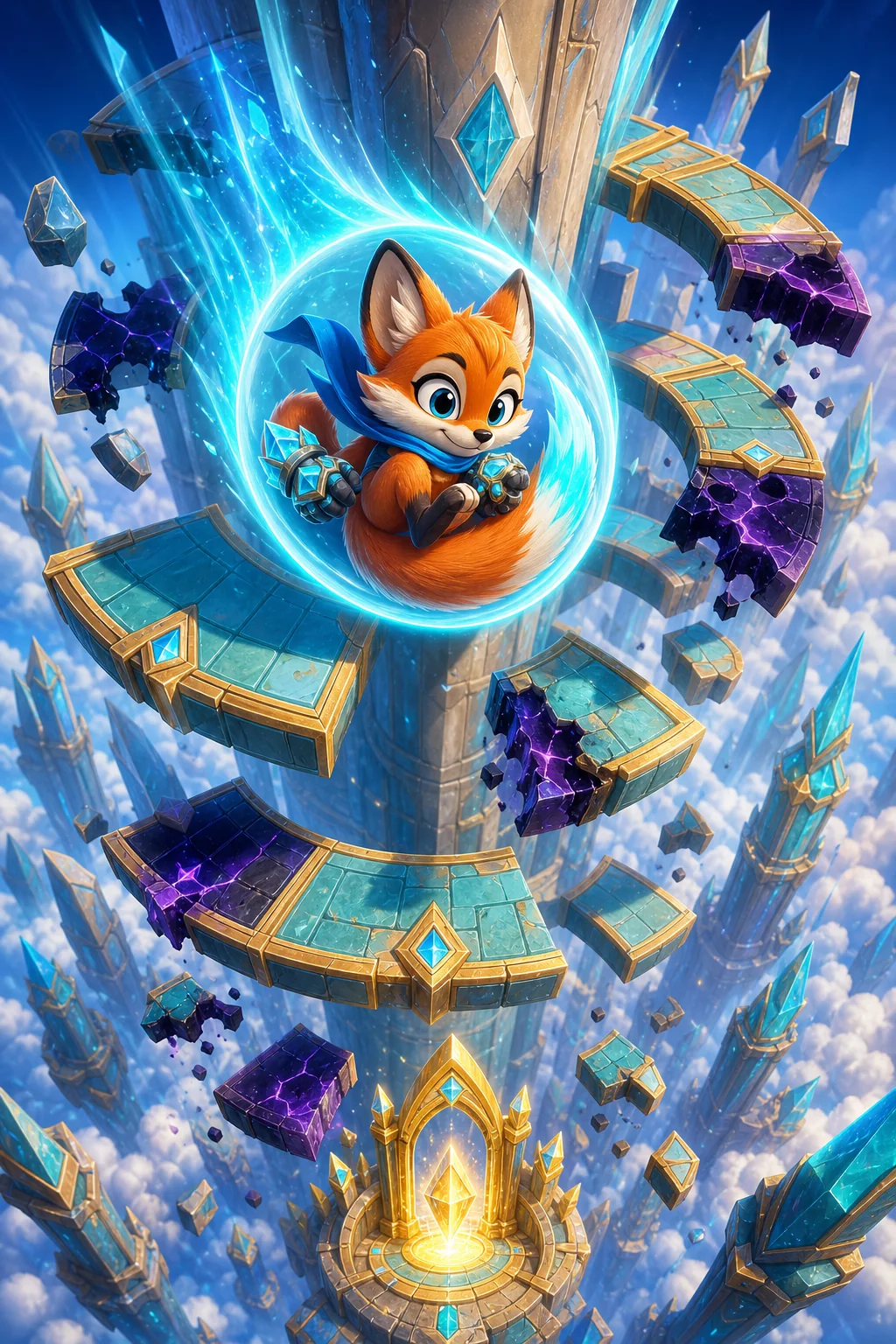
The first useful instruction I noticed in Animal Skyspire Drop was not a direction. It was a verdict: Next landing — Open path. I still had to rotate the crystal rings. The game had simply removed one piece of guesswork before asking me to make the decision.

That distinction is the design idea behind the current next-landing scanner. A falling character creates a timing problem: the player needs information while the game is moving, but a full solution would turn the movement into a formality. The scanner tries to sit in the narrow space between those two outcomes.
Tell me what is below, not what to press
Animal Skyspire Drop asks the player to rotate all the rings and guide Fia through a tower. The next sector can be an Open path, a Safe stone, a Cursed sector, or Fragile glass. Those labels describe the consequence waiting under the character. They do not say “drag left” or “press right.”
That leaves the important part in the player’s hands. I can choose a rotation, watch the verdict change, and decide whether to keep sweeping or commit to the opening. The interface gives me a readable state, not an autopilot.
The difference matters most with Safe stone. On my first Tower 1 retry at the English route and a 390 × 844 viewport, Fia bounced on a safe ring and stayed at 2 / 8. Waiting did not advance the descent. I had to rotate again, read the next state, and look for the open path. “Safe” meant “you have another moment,” not “the puzzle is solved.”
A visible warning makes failure more specific
My first meaningful failure came at 5 / 8. The badge showed Cursed sector, I did not get the ring lined up in time, and the result screen said: “The cursed sector stopped Fia.” Then it offered Retry.
That sentence is small, but it gives the failure a shape. I did not lose to an unexplained collision. I lost after seeing the category of risk and failing to respond. On the next attempt, the scanner became a reason to keep rotating: when it showed a cursed sector, I continued the sweep until the readout moved back toward a safer landing.
This is not proof that every player will understand the system immediately. It is one play session. It did show me what the failure was asking for, and Retry let me test that interpretation without sending me back through setup screens.
Assistance should preserve a decision
In the successful retry, I reached Tower 1’s rescue gate at 8 / 8 in 68.9 seconds, with a best combo of 6 and one star. The result was not especially fast. That is fine. The useful result was that I spent the run making timing choices instead of guessing what the next ring contained.
For a designer, the pattern is portable:
- Classify the next risk. “Open,” “safe,” “cursed,” and “fragile” are faster to act on than a paragraph about ring behavior.
- Keep the control open. The scanner does not rotate the tower, choose a direction, or protect the player from a bad commitment.
- Make the readout live. A warning that describes the previous ring is decoration. The label needs to follow the landing the player can still change.
- Pair the warning with a useful retry. A specific failure message and a quick Retry turn a mistake into the next experiment.
There is a temptation to make a difficult game friendlier by adding more instructions. Sometimes the better move is to add one accurate sentence at the exact moment a decision becomes hard. The player still falls. They just know what they are falling toward.
If you want to try the distinction yourself, play Animal Skyspire Drop and watch the badge after each landing. When it says Safe stone, do not assume you are done. Use the bounce to read the next ring.
This article was outlined with AI assistance and then checked and edited against the actual WeightPlay project and a hands-on play session by the WeightStudio team.