Pawflow
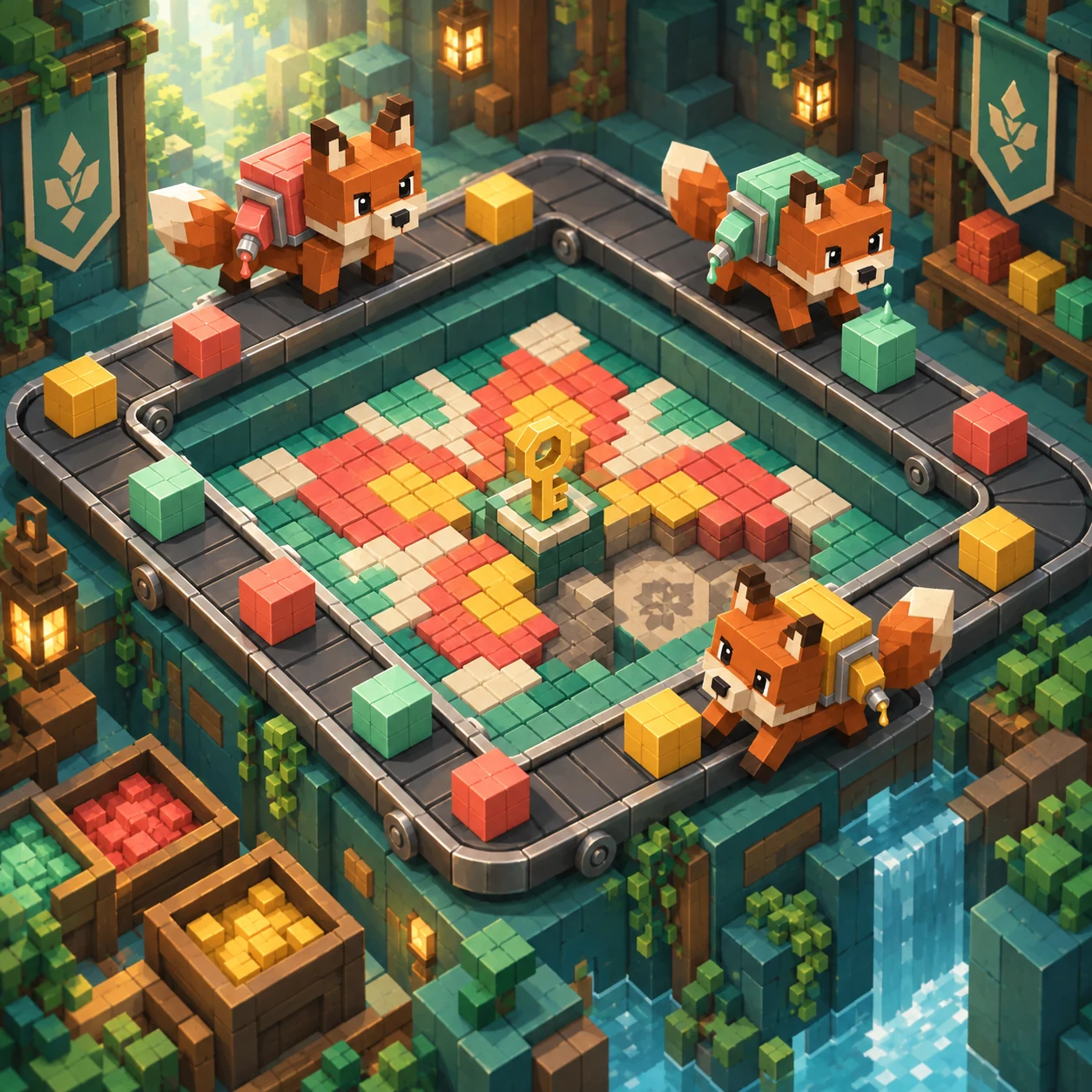
Send color couriers around the conveyor, clear matching pixels, and keep the waiting slots from filling.
Stage 1 / 30
Progress saves in this browser.
Send color couriers around the conveyor, clear matching pixels, and keep the waiting slots from filling.
Progress saves in this browser.
Send color couriers around the conveyor, clear matching pixels, and keep the waiting slots from filling.
Pawflow takes place in a small garden mosaic workshop. Block-built fox couriers carry limited tanks of color around a conveyor surrounding a picture. Your job is to choose their departure order, clear every pixel layer and prevent the waiting area from overflowing. The foxes move and shoot automatically; you decide which available courier should go next. A large patch of the right color is not always the best target, because a single outside pixel may block the path to an important inner area. Completed pictures unlock the next workshop stage. The campaign contains thirty authored boards, rather than a single random board repeated with a higher score target.
Select Start Game, then tap an unlocked stage card. Tap the first courier in one of the three supply queues, or tap a courier in one of the five waiting slots. Mouse clicks and touch use the same actions; keyboard keys 1–3 select supply heads and 4–8 select waiting slots. Tab and Enter also operate the controls.
A maximum of four couriers can occupy the belt. At each row or column, a courier looks inward and considers only the first occupied cell. It spends one charge only when it hits an exposed, unlocked pixel of its own color. Different colors and sealed pixels block the shot, rather than wasting a charge. A courier with no charges leaves. A courier with charges remaining parks after one lap and can be sent again. Returning to five occupied waiting slots loses the attempt. You also lose when no available color can make progress and no courier is moving. Clear all layers to win. The help panel and Settings pause the simulation.
Stages 1–5 teach exposed colors and waiting-space management. Stages 6–10 reveal lower layers; a new color may appear where a cleared pixel stood. Stages 11–15 add reinforced pixels that need two hits. Stages 16–20 introduce keys and a sealed center: remove every marked key before the center can be hit. Stages 21–25 alternate the open shooting sides. The final five boards combine these rules, with the thirtieth stage as the chapter finale. Each five-stage arc ends with a checkpoint puzzle. Daily puzzles safely vary an authored board and keep separate records; they do not replace campaign progression.
Read the outside colors before committing a valuable inner-color courier. Check the next two couriers shown behind each supply head. Reuse waiting couriers to free a slot before another returns. On shutter stages, read the Left/Right or Top/Bottom indicator; waiting changes access without spending a charge. The free Hint highlights a useful immediate choice, not a guaranteed complete solution. One Rewind, available from stage 6, restores the state before the last accepted dispatch. Neither assistance creates extra ammunition. A clear earns one star, meeting the displayed dispatch target earns another, and doing both without Hint or Rewind earns the third.
The board, conveyor, foxes and markers are real 3D geometry, while the game rules run in a separate fixed-step simulation. Camera changes never expose additional playable lanes or change legal actions. Colors also carry A–E symbols, so color alone is not the only identifier. The pointer and keyboard share dispatch limits. There is no countdown forcing a fast choice; planning between departures is part of the puzzle. Best stars and best dispatch counts only improve, making replay about understanding a board rather than purchasing an advantage. Gameplay is family-friendly and skill labels describe play activities, not medical or intelligence assessments.
The suggested age is 7+ and an attempt is designed for roughly two to eight minutes, depending on the board and choices. This is a single-player browser game requiring JavaScript and compatible WebGL graphics. No game account, purchase or advertising slot is required. Progress and active checkpoints are stored in this browser when storage works; clearing site data removes them. An unavailable store falls back to session-only progress with a notice. Reloading offers the saved attempt when its stage is selected. Leaving explicitly discards only that attempt. Backgrounding pauses without time catch-up. Daily puzzles change at midnight UTC and retain at most fourteen daily records.
Only the first occupied cell along its inward row or column can be hit. A different outside color, sealed pixel or closed shooting side blocks that opportunity. Clear a path or wait for the indicated sides to open.
No. After a lap, a courier keeps its remaining charges in a waiting slot. Tap that slot to send it again. An empty tank exits automatically, freeing belt capacity without occupying a waiting slot.
No. Hint previews immediately legal departures and suggests useful local progress, or asks you to wait. It does not search every future sequence, spend a courier or guarantee a complete solution from an already poor position.
Completed stages, unlocks and best records remain. A deliberate Replay starts the selected board from the beginning. A normal reload can restore a valid active checkpoint, but private browsing or unavailable storage may prevent persistence.
The workshop could not load. Reload or return to WeightPlay.